
Five steps from idea to filing packet.
Tell Sully what you're planning. Sully reads your town's rules first, writes the report, sizes the materials and assembles the packet the office asks for.

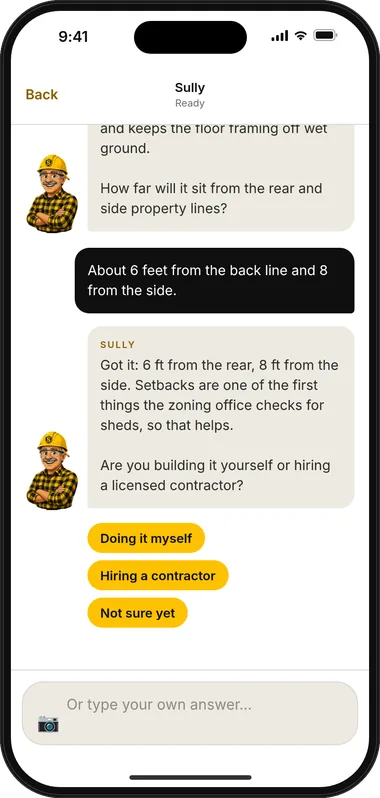
Tell Sully the project
Describe the project in plain words and give the city and state. That's enough to start.
- One question at a timeSully asks only what changes the answer for your project type: attached or freestanding, height, location on the lot, what's being moved. No twenty-field forms.
- Start from a sketchPhotograph a rough sketch, even on the back of an envelope. Sully reads the dimensions you wrote and builds a clean conceptual schematic, with missing numbers called out.
- Your words, prefilledAnything you already said, like the town or the size, is carried forward so you're never asked twice.
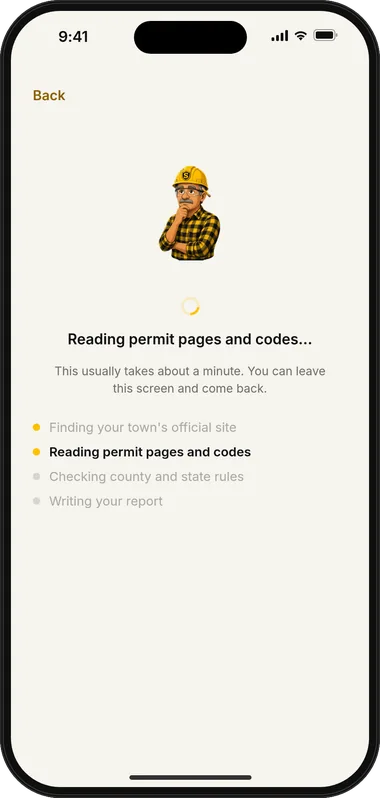
Sully researches your town
Sully reads the rules in a fixed order, closest to you first.
- Your links firstIf you paste a link to your town's ordinance, a handout or a page the office pointed you to, Sully reads it before anything else.
- Then the ladderThe town's official site, permit, fee, code and zoning pages; then the county; then the state; then the model code as a last fallback.
- Checked against sourcesPhone numbers, fees and quotes are checked against the pages Sully actually read.
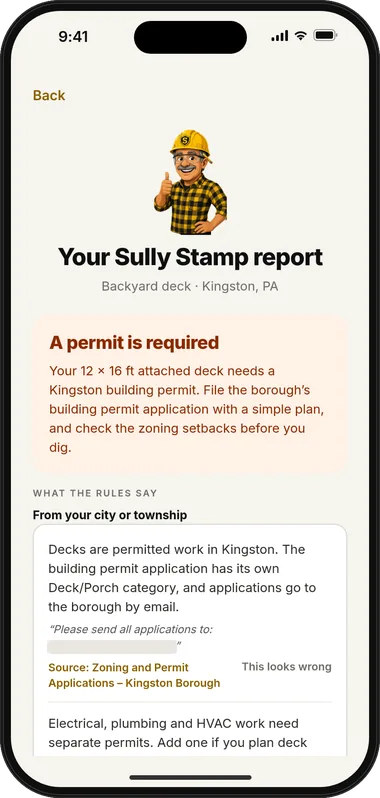
Read your permit report
A report you can act on, with its sources showing.
- A clear verdictRequired, likely, unclear or not required, with the reasons behind it.
- Rules grouped by sourceEach rule labeled Town, County, State or Model code, with a quote or paraphrase and a “this looks wrong” button.
- What to do nextFees, who to call, the town's own form when it's posted, ordered steps, common rejection reasons, and whether to hire a pro.
- Honest gapsIf a rule can't be found, the report says so and tells you who to call. Calling the office is part of the plan, not a failure.
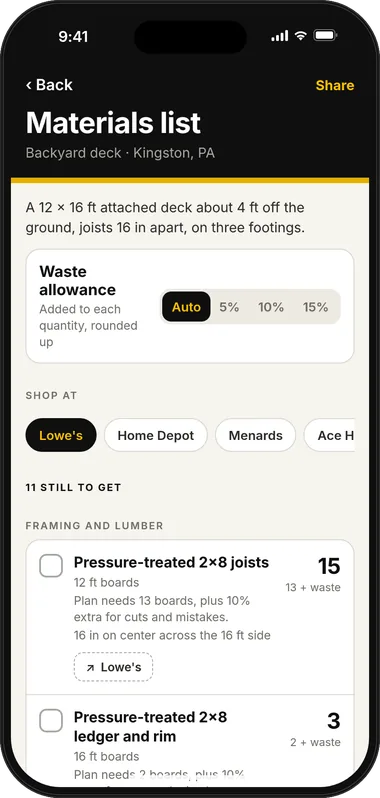
Build your materials list
Quantities you can trust, because they're only built from what you've confirmed.
- Waste allowance on every lineEach quantity includes an allowance for offcuts and mistakes, shown so you can change it.
- Assumptions statedJoist spacing, panel size, coverage: whatever the math assumed is written next to the item.
- Missing measurements called outIf the deck's height at the far corner is unknown, the list says so instead of guessing.
- Shop your wayA retailer picker turns each item into a plain store search at the retailer you choose.
Filing packet.pdf6 pagesSample
Backyard deck, 12 × 16Prepared for the Sample Town permit office
- Cover sheet with owner and property details
- Project details and schematic from your sketch
- Rules that apply, each with its source
- Checklist of what the office asks for
- Link to the town's own application form
Email to the officeSharePrint
Carry the filing packet
Everything the office asks for, organized in one PDF.
- What's insideA cover sheet, your project details and schematic, the rules with their sources, and a checklist of what your office asks for.
- The real formWhen your town posts its application form online, the packet links to it.
- Send itEmail the packet to the office from the app, or print it for the counter.
What Sully won't do.
Sully is a guide, not the permit office. Knowing the limits is part of using it well.
- Decide your permitYour local permit office decides. Sully helps you understand the published rules and prepare.
- Promise approvalNo tool can. A complete, well-sourced application simply gives you the best start.
- Replace licensed prosStructural, gas and major electrical work belong with licensed professionals, and some towns require them.
- Paste copyrighted codeModel code text is linked or paraphrased, never pasted.
Get Sully on day one.
Coming soon to iPhone. Tell us what you're planning and we'll send one email when Sully is ready. We read every project note, and it shapes which project types we polish first.
What are we building?